
Ductwork repair and sealing in Youngstown, OH
When one room is always too hot or too cold, or the furnace and air conditioner run without the air reaching where it should, the ducts are often the cause. HVAC Guy tests the duct system, seals leaks, reconnects and resizes runs, and adds return air where a house is short of it.
Signs of leaky or undersized ductwork
- One or 2 rooms are always several degrees off while the rest of the house is fine.
- Weak airflow at certain registers, strong at others.
- The second floor is hot in summer even though the air conditioner tests fine. This is the standard complaint in the Cape Cods of Brownlee Woods.
- Whistling or roaring at the return grille, or a filter that gets sucked out of shape.
- Booming or popping from the sheet metal when the blower starts and stops.
- A dusty house, with gray streaks on the carpet along baseboards or around registers.
- A basement that's warmer in winter than the rooms above it.
- The furnace shuts off on its high limit, or the AC coil freezes, with a clean filter in place.
- Visible gaps, fallen runs, or crushed flexible duct in the basement, attic, or crawl space.
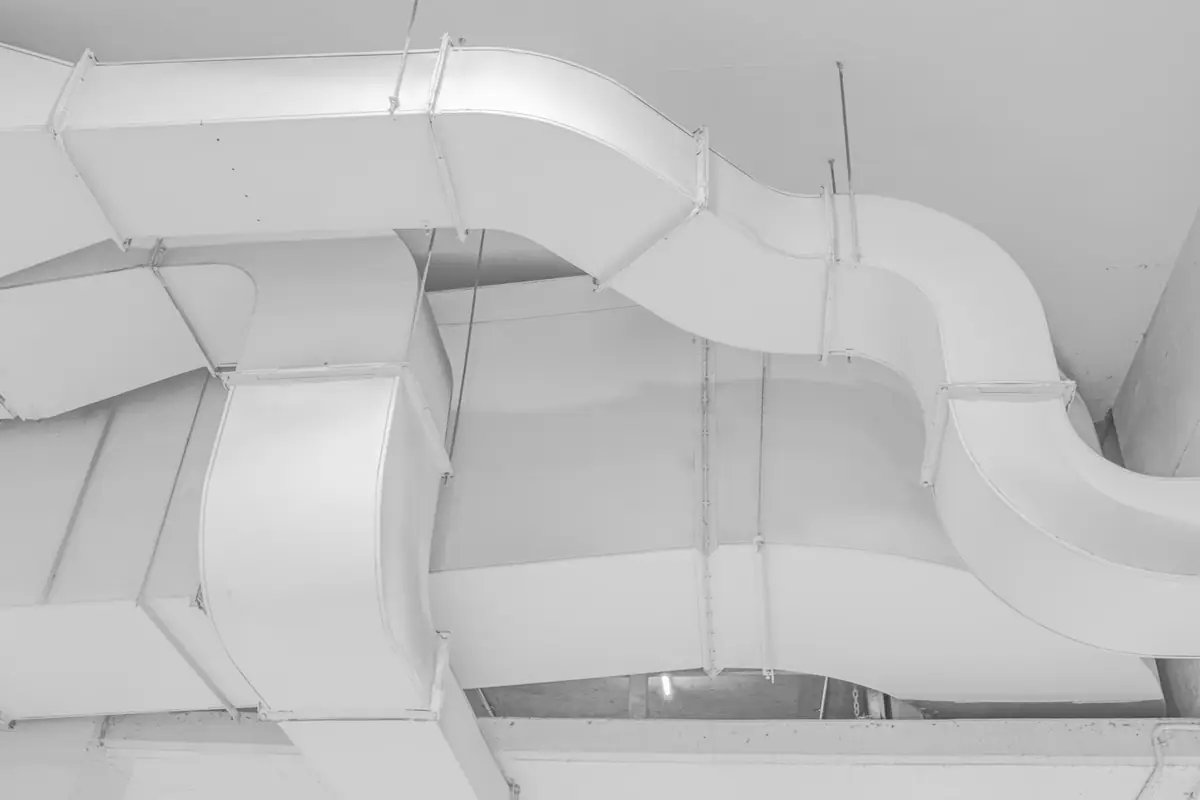
Common ductwork problems
- Leaks at joints and seams. Sheet metal ducts are assembled from sections that slip together. Unsealed, those joints leak a significant share of the air before it reaches the rooms.
- Disconnected runs. A branch duct pulls off its boot or takeoff, often after other work in the basement, and dumps air into a joist bay.
- Not enough return air. The blower can't push out more air than it can pull in. One undersized return starves the whole system.
- Undersized or overlong branch runs to rooms that were added or finished later.
- Crushed, kinked, or sagging flexible duct.
- Closed or seized dampers in the trunk line that someone set decades ago.
- Missing insulation on ducts running through attics, crawl spaces, or garages, so the air arrives lukewarm and the ducts sweat in summer.
How ductwork problems are diagnosed
We start with measurements at the equipment. Total external static pressure, taken with a manometer on the supply and return sides of the furnace, shows how hard the blower is working against the ducts.
Most residential blowers are designed for about half an inch of water column. Readings well above that mean a restriction, and comparing the supply side to the return side shows which half is the problem.
From there we measure temperature rise or drop across the equipment, check airflow at individual registers, and trace each run by eye: looking for gaps, loose connections, closed dampers, and crushed sections. The result is a specific list of what's wrong and what each fix would do, so you aren't asked to pay for a whole new duct system when 2 returns and a sealed trunk would solve it.
What ductwork repair and sealing includes
- Sealing. Joints and seams are sealed with mastic or foil tape rated for ducts. Cloth duct tape isn't used, since it dries out and falls off within a few years.
- Reconnecting and supporting loose runs, with proper fasteners and hangers.
- Adding return air: a new return duct and grille, or enlarging the return drop at the furnace.
- Replacing or upsizing branch runs to rooms that are short of air.
- Installing and setting balancing dampers so air can be shifted between floors by season.
- Insulating ducts in unconditioned spaces.
- Rebuilding plenums and transitions at the furnace that are too tight or poorly shaped.
After the work, static pressure and airflow are measured again so you can see the change in numbers. One clarification: this is repair and modification of the duct system. Duct cleaning is a separate service.
Leaky return air ducts in Youngstown's mid-century houses
A large number of homes in Youngstown and its inner suburbs were built in the 1940s through the 1960s, and many of them have what the trade calls panned returns. Instead of a sealed sheet metal duct, the builder nailed a flat piece of metal across the bottom of 2 floor joists, and used the space between studs inside the walls, to carry return air back to the furnace.
Wood framing isn't airtight. A panned return pulls air from wherever it can: the basement, the rim joist, wall cavities, and gaps around plumbing. That has 3 effects a homeowner notices.
The system draws in damp, dusty basement air and distributes it through the house. The rooms that are supposed to feed the return get little pull, so they stay stuffy. And in a tight basement, a leaky return can pull hard enough on the room to disturb the draft of a gas water heater or furnace vent, which is a safety issue.
Sealing or lining those joist bays, or replacing them with real duct, is often the single most effective duct repair in a house of this age.
These houses also frequently have gray or white tape on the duct joints, or paper-like wrap, that may contain asbestos. It can't be identified by looking at it.
We don't cut or scrape it. If it's in the way of a repair, it has to be dealt with by a licensed abatement contractor first.
Ductwork repair cost: What affects the price
- Scope. Sealing accessible joints is a small job. Adding returns and replacing runs is larger.
- Access. Open basement ceilings are easy. Finished basement ceilings, crawl spaces, and attics take longer, and some ducts behind finished surfaces can't be reached without opening them.
- Material. Sheet metal fabrication costs more than flexible duct.
- Carpentry and patching. A new return grille means cutting a wall or floor.
- Insulation for ducts in unconditioned spaces.
- Suspected asbestos, which stops work until it's tested or abated.
The price is based on the specific list of repairs found during testing. You can do all of it or start with the items that make the most difference.
When a duct problem is an emergency
Most duct problems are comfort and efficiency issues that can be scheduled. These are the exceptions:
- A carbon monoxide alarm or signs of flue gas spilling near the furnace or water heater. A leaking return next to the equipment can pull exhaust into the air stream. Leave the house and call 911.
- A duct has fallen in a crawl space or attic in freezing weather and the house is losing heat, with plumbing nearby at risk.
- The furnace is shutting down repeatedly on overheat and the house is getting cold.
- Water dripping from ducts or registers onto ceilings or wiring.
For any of these, call our emergency line.
After your ductwork is repaired
Keep supply registers and return grilles clear of furniture and rugs. Don't close registers in unused rooms, because that raises pressure and pushes more air out of any remaining leaks. If balancing dampers were installed, adjust them at the change of seasons as the technician showed you.
If duct problems were found while planning new equipment, fix them first: a new furnace connected to a starved duct system will short cycle the same way the old one did. HVAC Guy handles the equipment and the air distribution together as a heating and cooling contractor in Youngstown.
Ductwork repair questions from homeowners
Why is one room in my house always colder than the others?
That room is getting less air than it needs. The usual causes are a long or undersized duct run, a leak or disconnection along the way, a closed damper, or no path for air to return from the room when the door is shut.
Does duct sealing make a noticeable difference?
In houses with leaky ducts in a basement, crawl space, or attic, yes. More of the heated or cooled air reaches the rooms, run times shorten, and less dust is drawn in through return leaks.
Should I close vents in rooms I don't use?
No. Closing registers raises the pressure in the ducts, which increases leakage and can make a furnace overheat or an AC coil freeze. Leave them open, or have balancing dampers installed and set correctly.
Is duct repair the same as duct cleaning?
No. Duct cleaning removes dust and debris from inside the ducts. Duct repair fixes leaks, restrictions, and sizing problems that affect airflow and comfort. HVAC Guy does repair and modification.
Can you add a return air duct to my second floor?
Often, yes. A return can sometimes be run through a closet, a wall cavity, or an old chase. Where no route exists, other options are transfer grilles between rooms or a separate system for the upper floor.
Uneven rooms or weak airflow? Have the ducts tested
Call HVAC Guy and tell us which rooms are the problem and whether it's worse in summer or winter. That pattern points to supply, return, or leakage before we have opened the basement door.